


Product statusR&D and PoC

Making care truly fit every patient

Built on 3D medical implants generation, diagnostic imaging analysis, and medical engineering, we develop patient-matched healthcare solutions that professionals can review, use, and deliver.

Team expertise and industry engagement

Monash Centre for Additive Manufacturing (MCAM)/Monash Medical Centre/AgiBot 智元机器人

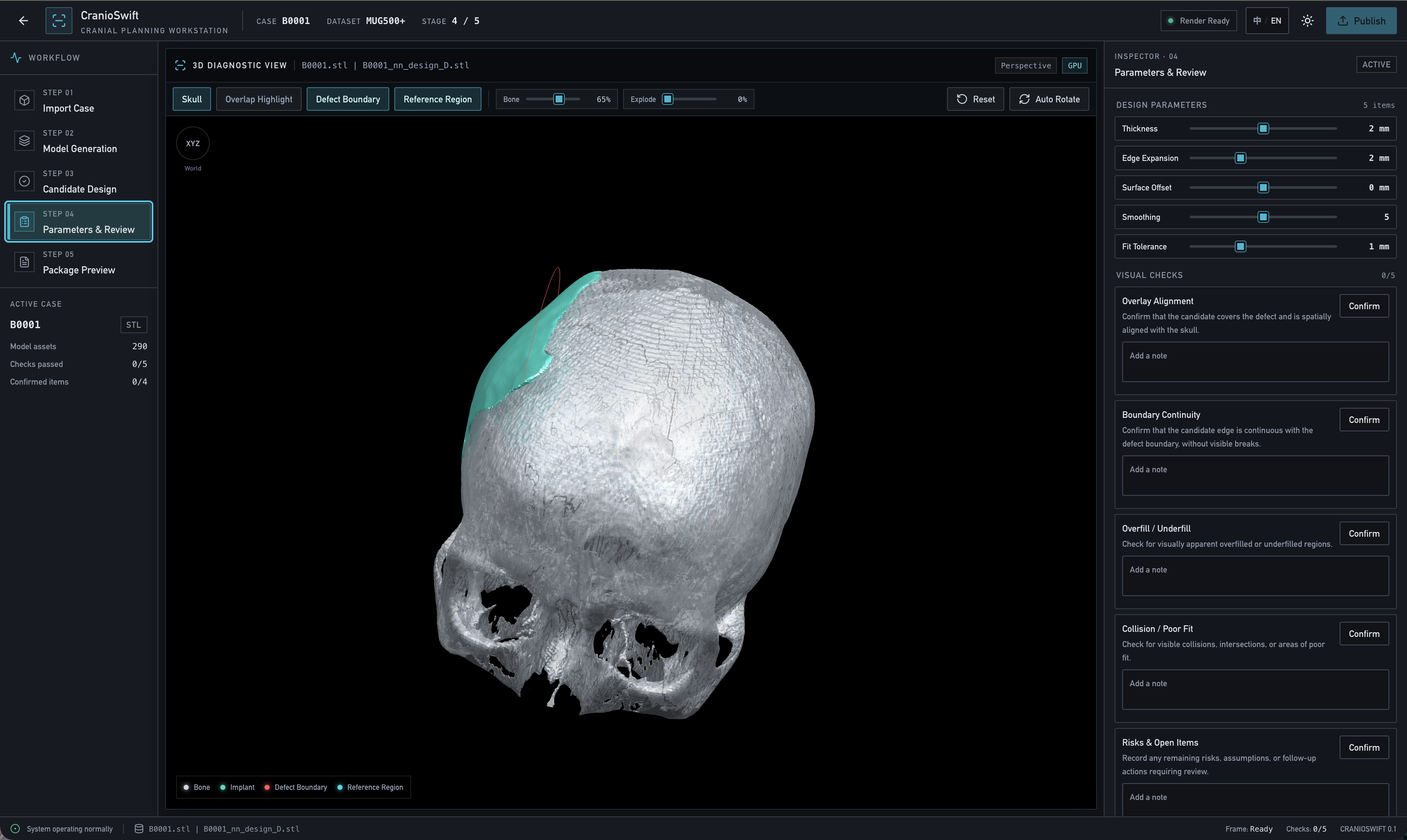
Maxillofacial Starting with cranial reconstruction, advancing patient-matched implants

FIG.101

Cranial defect reconstruction

Connect case intake, design collaboration, version evidence, and manufacturing handoff on a controlled, traceable, and verifiable quality foundation.

  1. 0.1Check case materials, anatomy, professional objectives, and timing requirements
  2. 0.2Bind feedback, reasons for changes, and approval status to specific versions
  3. 0.3Keep the confirmed version, manufacturing constraints, and handoff record aligned
Explore cranial reconstruction
FIG.202
fitmed/case-delivery-baselineCase baseline
Input completenessTo record
Active engineering timeTo record
Revisions and reworkTo record
Open issuesTo record
Manufacturing returnsTo record

Maxillofacial and complex orthopaedics

Continue customer discovery and product evaluation around complex anatomy, reconstruction objectives, and manufacturing constraints.

  1. 0.1Reverse-map the current process from one completed case
  2. 0.2Record missing inputs, waits, revisions, rework, and version issues
  3. 0.3Establish a validation baseline with an agreed consecutive case set
Explore validation
FIG.303
Delivery stabilityConsecutive cases

Case intake

Checked

Professional objective

Confirmed

Candidate design

V04

Clinical review

In progress

Version confirmation

Pending

Manufacturing handoff

Pending

Case workflow

Bring case information, professional objectives, candidate designs, review, version confirmation, and manufacturing handoff into one chain of responsibility.

  1. 0.1Make case progress and open issues visible to the team
  2. 0.2Keep clinicians, engineers, quality, and manufacturing teams aligned on one version
  3. 0.3Manage case-delivery data separately from model-training data
Try FitMed Demo
FIG.404

Candidate design and manufacturing handoff

Keep professional review inside the workflow and in the record; manufacturing receives more than a geometry file.

  1. 0.1Specialised models generate candidates only for authorised and validated tasks
  2. 0.2Professional engineers review, revise, and confirm candidate designs
  3. 0.3Manufacturers retain responsibility for process validation, inspection, and product release
Free consultation
“We do not use automation to replace decisions that belong to accountable professionals. Technology organises, checks, and repeats; people retain experience, responsibility, and final judgment.”

FitMed AI

Product principle | Professional responsibility

“Every comment should point to a version, and every confirmation should identify its object. Process and evidence remain traceable, while automation does not hide uncertainty.”

FitMed AI

Product principle | Process traceability

Case-delivery workspace

Keep the inputs, decisions, versions, and handoff for each case moving through one workspace, reducing repeated searches and late-stage rework.

View workflow
Key stages5 · Full workflow

fitmed/case-input

Case intake: flag missing, conflicting, or unconfirmed information

case datacompleteness+1
Stage 01Input check · Controlled

fitmed/clinical-review

Clinical-engineering review: bind feedback, reasons, and open issues to versions

clinicianengineer+2
Stage 03Collaborative review · Recorded

fitmed/version-handoff

Version confirmation: show the current version and unresolved items clearly

versionhandoff+1
Stage 05Manufacturing handoff · Traceable
Case status● ● ●

Current version · V04

Input completeness: checked
Clinical objective: confirmed
Engineering review: in progress
Open issues: 2
Manufacturing handoff● ● ●

Pre-handoff check

Design requirements: linked
Manufacturing constraints: reviewed
Confirmation record: traceable
Product release: accountable party
Responsibility boundaries

The system proposes; professional responsibility remains.

Clinicians define clinical objectives, professional engineers review and revise candidates, and the relevant accountable parties complete final design confirmation, process validation, manufacturing, inspection, and product release.

Case data

Only authorised data is processed

Candidate design

Reviewed and revised by professional engineers

Manufacturing release

Completed by the accountable party

Dental Starting with oral and maxillofacial imaging and complex anatomy, we identify focused tasks ready for product validation.

FitMed focuses on teeth, periodontal structures, the maxilla and mandible, the temporomandibular joint, and related oral and maxillofacial anatomy, advancing products around imaging findings, diagnostic evidence, patient variation, and professional workflows.

Oral and maxillofacial imaging

Cover dental radiographs, panoramic imaging, cone-beam CT, and related X-ray, CT, and MRI studies to organise relationships between lesions and complex surrounding anatomy.

Dentomaxillofacial lesion analysis

For defined tasks, organise key findings, diagnostic evidence, differential considerations, and evidence gaps into a draft report for professional review.

Patient-matched dental products

Continue identifying focused tasks worth taking into product validation across anatomy, professional objectives, materials, and manufacturing requirements, without presenting research directions as validated products.

Workflow

The system drafts. The doctor finalises.

FitMed organises imaging findings, diagnostic evidence, differential considerations, uncertainty, and necessary follow-up suggestions; doctors review, revise, and sign the report using complete patient information.

Free consultation
01Imaging findings
02Diagnostic evidence
03Evidence gaps
04Doctor review
05Report sign-off

Medical Imaging Analysis Seeing an abnormality is only the start; explain the evidence and build a reviewable report.

Report support

From imaging findings to a reviewable report.

FitMed is developing a doctor-reviewed report-support product for independent imaging centres and multi-site imaging service providers.

1.1

Make key findings visible

Organise lesion location, extent, morphology, density or signal characteristics, and relationships with surrounding anatomy.

1.2

Make the reasoning clear

Place supporting imaging evidence, differential considerations, and information that could change the conclusion in one reasoning chain.

1.3

Flag insufficient evidence early

When image quality, coverage, prior studies, or key clinical information is insufficient, identify evidence gaps and items requiring review.

Explore imaging analysis
Analysis focusReport workflow
In development

Maxillofacial

Priority area

X-ray / CT / MRI

Skull and skull base · Facial and jaw bones · Complex anatomy

Oral imaging

Priority area

Dental / panoramic

Teeth and periodontium · Maxilla and mandible · Temporomandibular joint

Spine

Priority area

X-ray / CT / MRI

Vertebrae and discs · Canal and nerve roots · Paraspinal tissues

Musculoskeletal

Priority area

X-ray / CT / MRI

Bone and joints · Cartilage and ligaments · Muscles and tendons

Imaging findings

Priority area

Task-defined

Location and extent · Morphology and signal · Surrounding anatomy

Diagnostic evidence

Priority area

Doctor review

Supporting findings · Differentials · Uncertainty

Evidence gaps

Priority area

Priority review

Image quality · Prior studies · Clinical information

Draft report

Priority area

Doctor finalises

Structured expression · Revision record · Sign-off workflow

Clinical focus

Focused on bone and joints,
advancing deeper imaging analysis.

1.1

Maxillofacial and oral imaging

Focus on the skull, skull base, facial bones, maxilla and mandible, temporomandibular joint, and surrounding complex anatomy.

1.2

Spine imaging

Focus on vertebrae, discs, the spinal canal, cord and nerve roots, spinal alignment, and paraspinal soft tissues.

1.3

Musculoskeletal and joint imaging

Focus on bone, joints, cartilage, ligaments, muscles, and tendons across X-ray, CT, MRI, and ultrasound.

FIG.7Report pathway

Professionals retain decision authority

Signed after doctor review

In development

Key finding checkCheck systematically
Evidence organisationReview along evidence
Differential explanationState uncertainty
Evidence-gap flaggingHighlight review items

Product output

Reviewable draft report

Robotics Working with AgiBot to bring embodied intelligence into real healthcare service workflows

Explore the partnership

Two independent product lines

About the team

A team spanning medical engineering, artificial intelligence, and enterprise software

The team combines experience in medical additive manufacturing, implant-design workflows, enterprise software, artificial intelligence, 3D interaction, and product commercialisation to turn professional problems into software products that can be developed, validated, and delivered.

Meet the team
FitMed AI team